Permit Planning Guide
Do I Need Council Permits for Crane Hire in Adelaide?
How to identify potential public-space approvals and plan the permit discussion for an Adelaide crane lift.
Possibly. Council permits for crane hire in Adelaide depend on where the crane, its outriggers, support vehicles and work zone will be, and whether the lift affects a public road, parking lane or footpath. A crane set up entirely within a suitable private site can raise different council questions from one that occupies the street. The exact requirements must be checked with the council or road authority responsible for the location.
This guide explains the early questions to ask when planning crane hire in Adelaide. It is general project-planning information, not a permit determination or legal advice. Councils can change their forms, lead times and conditions, and a permit for one site does not cover another.
First establish whether the public space will be affected
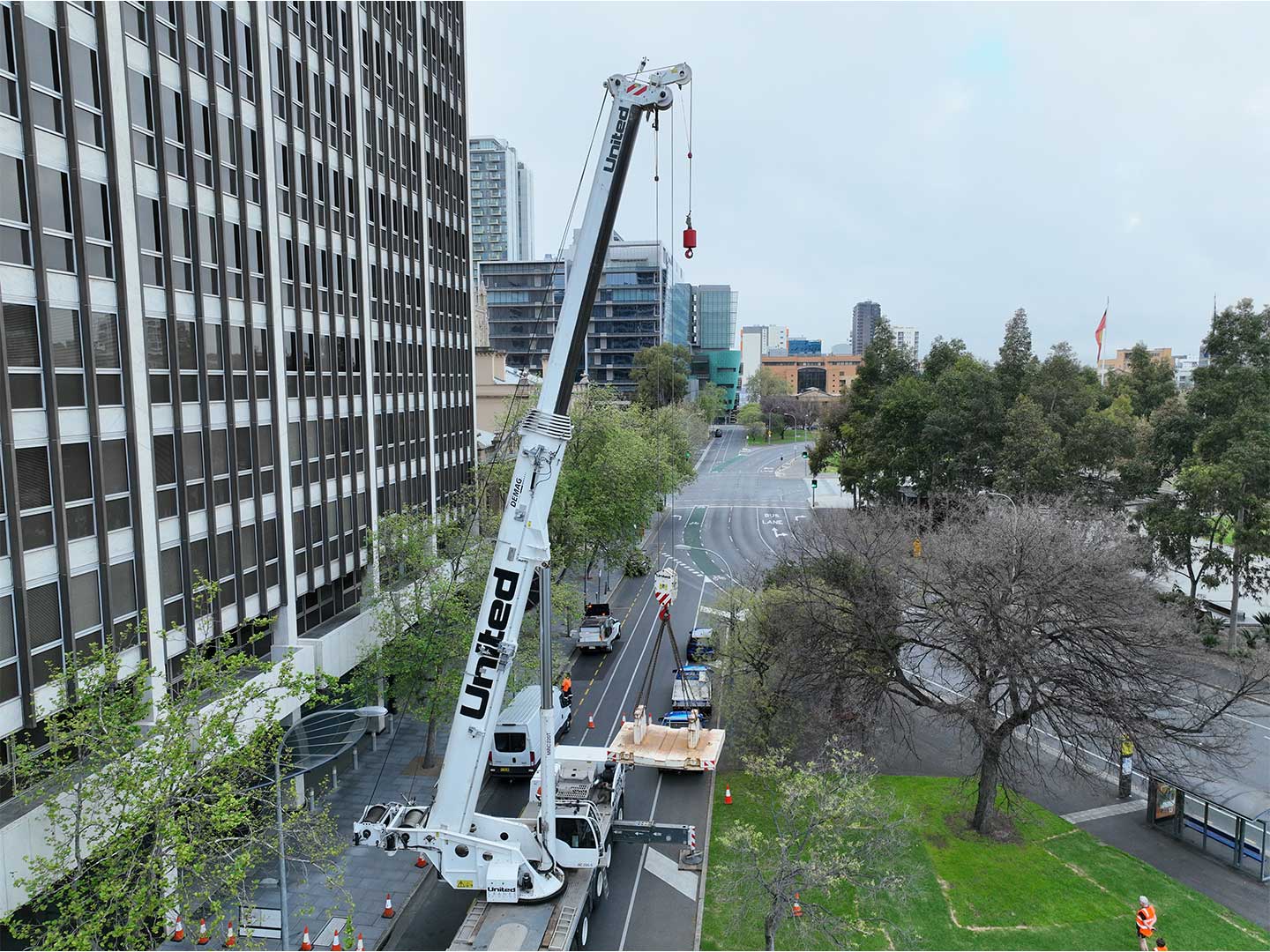
Draw the proposed crane position and work zone on a site plan. Mark the carriageway, parking spaces, verge, footpath, property boundary, outriggers, delivery vehicle position and the path of the load. Ask whether pedestrians, cyclists or vehicles will have to change their normal route at any stage, including setup and pack-down.
The City of Charles Sturt specifically lists crane or truck activity that causes a partial or full road or footpath closure as a public-space occupation requiring approval. Its application material calls for a traffic management plan, a plan showing dimensions and evidence of public liability insurance. The council also describes consultation with affected stakeholders. That is a useful example of the level of preparation a street-based lift can involve; it is not a rule that every Adelaide council uses the same form or conditions.
An existing building or development approval does not necessarily authorize occupation of public space. The City of Unley tells applicants that a separate road-occupation permit may be needed after development approval when works affect traffic, parking or temporary closures. Check these approvals as separate items in the project program.
Which authority should you contact?
Start with the local council for the exact address, and identify the road manager if the work is on a major road. The council can tell you whether a city-works, road-occupation, footpath-occupation or similar process applies. If the site crosses a boundary or affects a state-controlled road, further authority may be involved. Do not infer the authority from the business’s postal suburb or the crane company’s address.
The City of Adelaide uses a City Works permit process for activities in the public realm. A project in the central business district can face different pedestrian, loading and traffic constraints from a suburban site. Likewise, a lift near a school, hospital or busy retail frontage may need special timing and consultation. Ask the authority about the specific work zone and hours rather than treating a published example as automatic approval.
Mobile cranes can also have road-travel requirements as special-purpose vehicles. Those requirements concern moving the vehicle on the road and are separate from permission to occupy public space for the lifting operation. The South Australian Government’s special-purpose vehicle guidance is a starting point for that distinction; the transport operator should confirm the applicable notice or permit for its route.
What is usually needed for an application?
The authority’s current form controls the answer, but a complete enquiry commonly needs the site address, dates and hours, a scaled or dimensioned plan, equipment description, the area to be occupied, and a contact for the works. A traffic management plan may be required where vehicles or pedestrians are affected. The council may ask for insurance evidence, stakeholder notifications, a site plan, and details of how access to neighbouring properties will be maintained.
Do not draft the traffic plan from memory. Engage the people qualified and responsible for the traffic controls and use the authority’s current requirements. The plan must account for setup and pack-down as well as the lift itself. A vehicle lane may be affected even if the load is lifted wholly over private land.
In Charles Sturt’s published process, an assessment period begins after the application is complete; some closures can need a much longer lead time. Unley advises arranging road-occupation approval ahead of works. The practical lesson is to ask early and submit complete information. A hoped-for lift date is not a permit approval, and availability of a crane does not replace the authority’s decision.
How should a project team sequence the work?
Begin with a preliminary lift concept and site plan. Confirm the load information, likely crane position, access route, affected public area and intended date. Ask the crane provider what information it needs for its own planning, then contact the relevant council or road authority to establish the current application path. Allocate time for any traffic plan, insurance documents, notifications and revisions.
Keep a record of which party is responsible for each application and condition. On a building project, the principal contractor, developer, traffic-management provider and crane operator may all contribute information, but one party should coordinate the permit package. Confirm who will hold the approval on site and who can stop or reschedule the operation if conditions change.
At the final site review, compare the approved occupation area and hours with the proposed crane setup and lift plan. If the crane, work zone, road closure or timing changes, ask the authority whether the approval must be amended. Do not assume an earlier permit covers a materially different plan.
Does a private-site lift need no other checks?
Working within the property boundary may avoid a council public-space occupation permit for that operation, but it does not remove safety duties or site constraints. Ground bearing, underground services, overhead electric lines, exclusion zones and access still need assessment. Other project approvals or property permissions may apply. Ask the council about your site if there is doubt about the boundary or public impact.
An apparent shortcut, such as setting outriggers across a footpath for only a few minutes, can still affect the public realm. Consider the full period from arrival to departure. The question is what the operation actually occupies or restricts, not how briefly the main lift lasts.
What should you send when asking for a crane quote?
Share the site address and drawings, load details, proposed lifting and landing positions, intended date and any known road or footpath impact. State whether a council has already been contacted and provide any permit conditions or traffic-plan draft. If the site is still at concept stage, say which details are provisional. This helps avoid planning around an assumed access arrangement that later proves unavailable.
For the service overview, see United Cranes’ Adelaide crane hire page. Discuss the proposed lift and public-space constraints early so the team can identify what needs to be confirmed before a date is committed.
Sources and further reading
City of Charles Sturt, Public Space Occupation; City of Unley, Once you have development approval; City of Adelaide, City Works; SA.GOV, Special purpose vehicle requirements.
Discuss your crane hire requirements
Share the site, load, access and timing details with United Cranes so the right planning questions can be addressed.
Related services
This article is general project-planning information, not a permit determination or legal advice. Check current requirements with the responsible authority.